
.jpg)
What is Chainlink Runtime Environment?
Chainlink Runtime Environment (CRE) is a recently launched decentralized orchestration layer for all Chainlink services.
It is designed for institutions and developers building high-assurance, cross-chain, compliance-aware smart contract systems. As Chainlink node operators, we at Deepbase actively support CRE workflows through maintaining infrastructure that ensures secure and verifiable execution.
How does Chainlink Runtime Environment work?
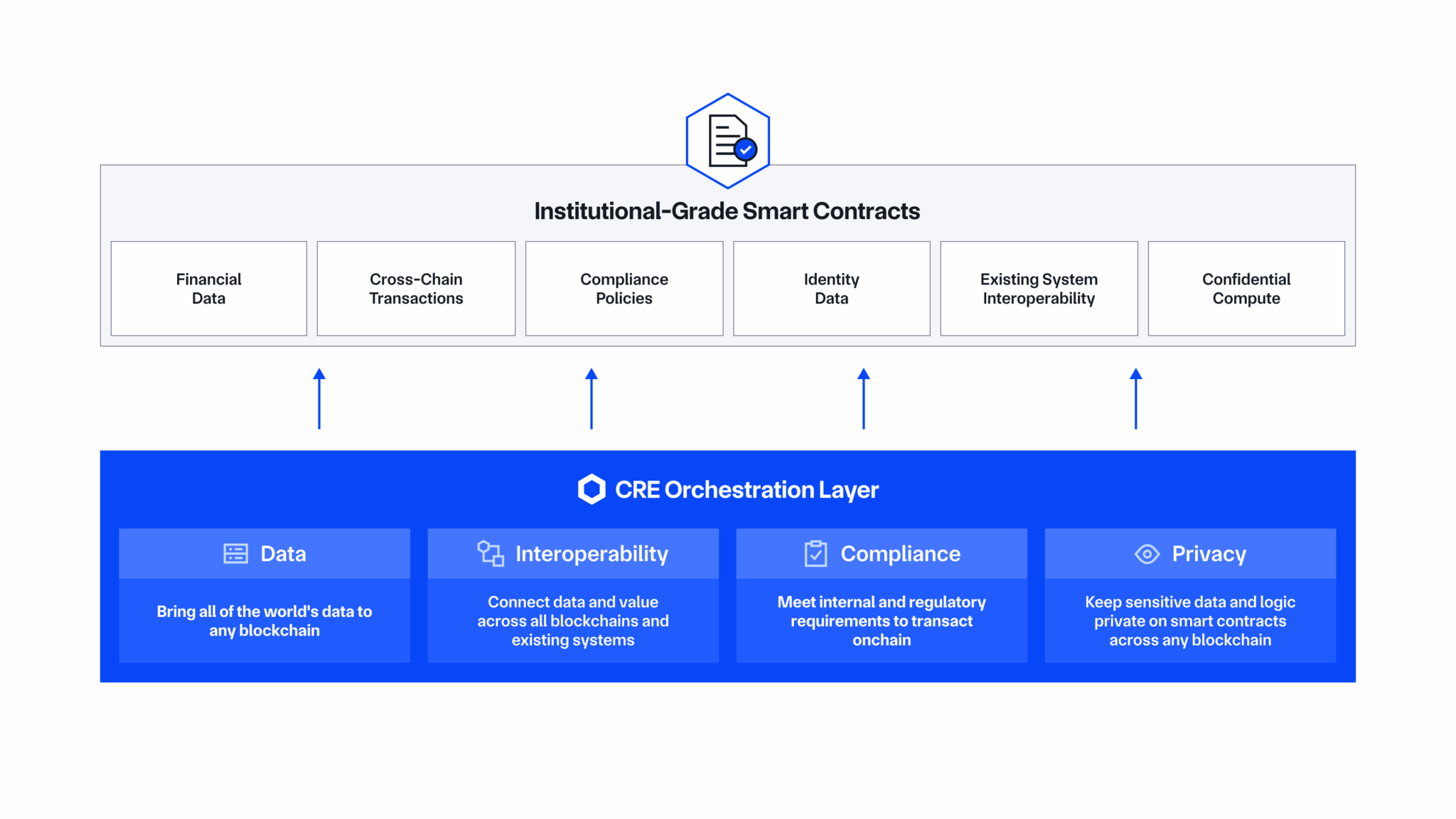
Chainlink Runtime Environment is a layer for building workflows: institutional-grade smart contracts to handle high-value financial processes in automated and regulated environments. For example, a stablecoin issuer can trigger automatic minting once KYC and bank settlement are confirmed—all executed by Chainlink nodes.
In general, all workflows consist of:
- Trigger—an event that starts the workflow execution
- Fetching—fetching data to use in the workflow
- Computation—transforming fetched data
- Writing—writing results to blockchains or Web2 systems
For example, one can build a simple workflow to fetch ETH prices from an exchange and store them in a contract for later use. Or create a complex workflow to monitor off-chain FX rates across multiple sources and mint stablecoins when regulatory conditions are met, such as AML checks and jurisdictional constraints, then settle cross-chain via CCIP.
What use cases does CRE open for blockchains?
Chainlink Runtime Environment simplifies asset tokenization and enables new tokenization workflows:
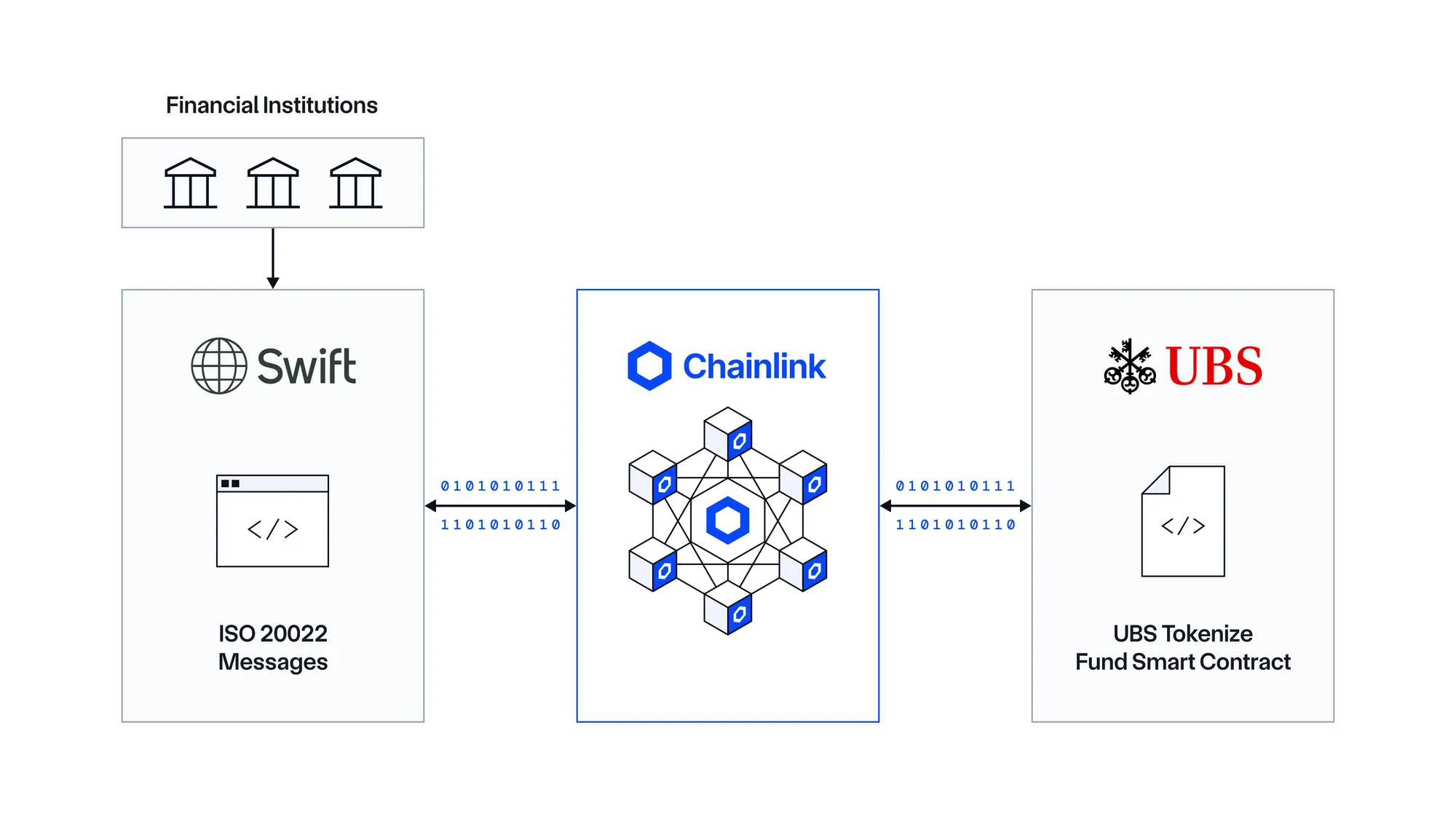
- Tokenize funds and manage issuance or redemption on-chain while maintaining ISO 20022 messaging for custodians and registrars. With CRE, users can pull NAV, perform whitelist checks, execute transfers, and generate audit receipts.
- Orchestrate atomic Delivery versus Payment (DvP) settlements for tokenized assets. CRE coordinates the asset leg on-chain and the cash leg through traditional banking rails, enforcing policy and proving finality.
- Settle tokenized trades through existing payment networks. With CRE, stablecoin issuance can be triggered by wire or card payments, automatically matching confirmations and finalizing on-chain settlements by updating books in a fully automated process.
The possibilities of automating Web2, Web3, and cross-chain interactions are limitless, especially for tokenized Real World Assets.
How Chainlink Runtime Environment is different from similar solutions
It’s possible to build a workflow that performs similar functions, like fetching and writing data after a trigger event. But Chainlink focuses on institutional usage and reliability.
The first thing to know is that in CRE, each Chainlink Service is called a Capability, executed by Decentralized Oracle Networks (DONs). Every Capability, such as fetching data, computation, or writing to a blockchain, is handled by its own DON.
CRE orchestrates complex workflow execution across Capability DONs—which Deepbase is part of—to make all actions and results provable, cryptographically verifiable, and without single points of failure.
This means each step is run by 20+ Chainlink oracle nodes, and the result is cryptographically verified using a BFT consensus mechanism. When the trigger-dedicated DON agrees that the event happened, the fetching-dedicated DON of another dozen nodes takes over to fetch and verify data, then invokes the next DON, and so on.
Using DON ensures that no mistakes or external interventions can occur during execution, as every step is verified by the same network that already secures trillions. The whole system is secure, robust, and trustless.
How Chainlink Runtime Environment addresses institutional needs
Chainlink aims to help institutions join Web3 by building tokenization and moving their assets on-chain with all the associated benefits. Unlike regular users simply swapping tokens, enterprises must comply with regulations.
Chainlink CRE includes built-in support for regulatory and privacy requirements, such as access control, identity, and compliance rule modules. Upcoming Chainlink Confidential Compute enables workflows to run computations in trusted execution environments, allowing sensitive data to be processed on-chain while remaining private.
Additionally, the Chainlink team made the Runtime Environment simpler for developers who are not Web3 specialists. Enterprises can build workflows in familiar Go and TypeScript instead of Solidity. Each Chainlink service is separated into a specific Capability DON, such as data reading and writing, cross-chain messaging, compliance, and computation, making it easy to construct workflows from modular components. Finally, workflows are standardized for any EVM-equivalent chain, allowing enterprises to use and combine both public and private chains depending on their needs.
Compared to traditional monolithic smart contracts, CRE brings stability and simplicity. When building a workflow from scratch, devs had to link components designed with different principles, hosted on different infrastructure, and which often weren't meant to be used together. CRE provides one environment to build with all familiar Chainlink services run on nodes across the globe. It's just safer and simpler to use CRE.
Who is already using Chainlink Runtime Environment?
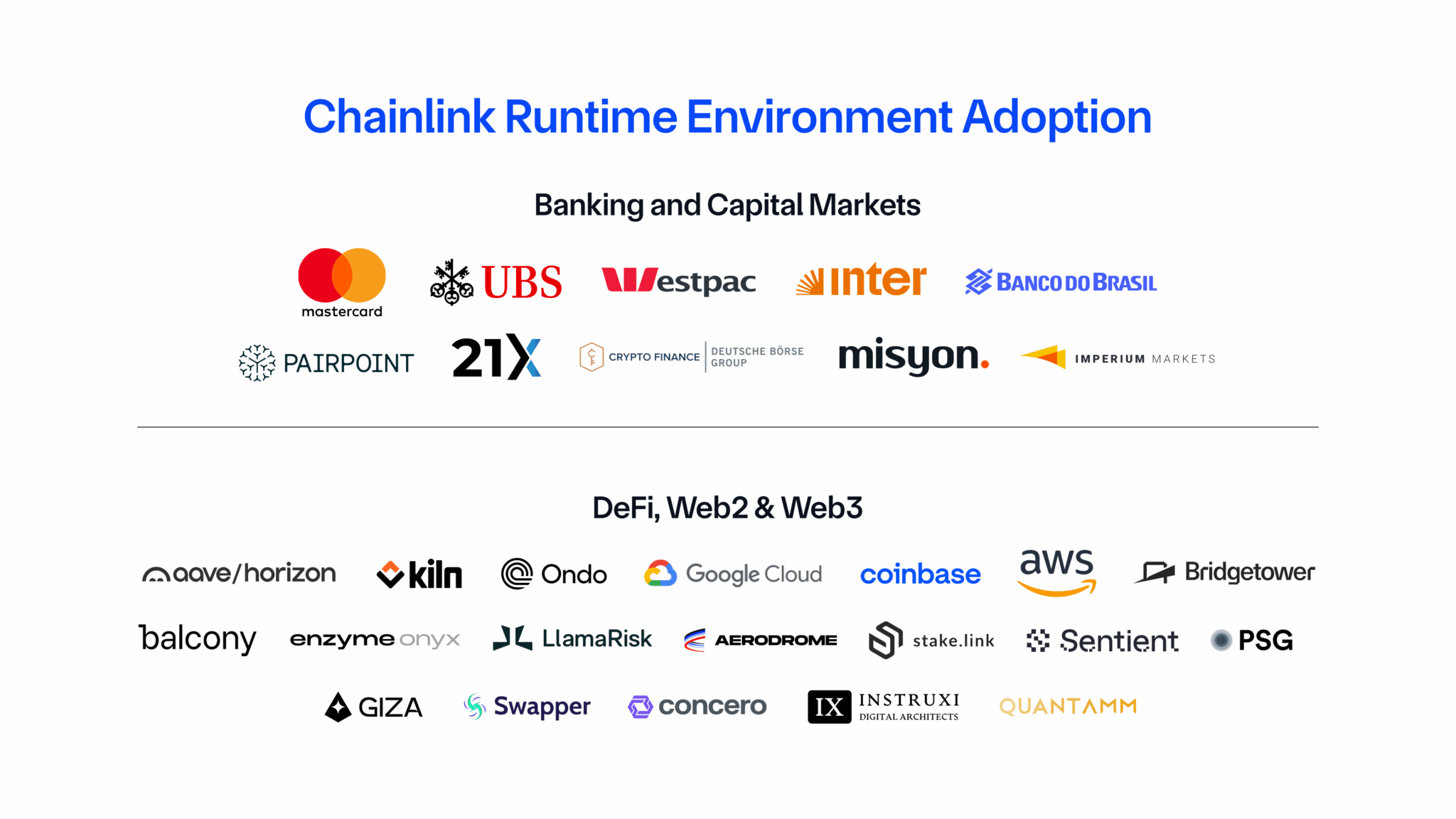
Early adopters were allowed to test and build workflows with CRE before others. Naturally, the first ones were large institutional firms that had partnered with Chainlink in previous years:
- J.P. Morgan: Kinexys used CRE for atomic cross-chain DvP transaction between public and private chains.
- UBS: UBS Tokenize ran the first production tokenized-fund subscription/redemption using Chainlink’s DTA standard powered by CRE
- Swift: Corporate actions initiative where CRE validates outputs and formats ISO 20022 messages sent over Swift
- Euroclear: Gathered 22 leading financial market participants to streamline corporate actions with CRE
- Mastercard: Co-developed a card-to-DEX purchase flow on CRE with Swapper
- Deutsche Börse Group (Crypto Finance): Built an on-chain Proof-of-Reserve attestation orchestrated by CRE for regulated ETPs
- Google Cloud and Amazon Web Services: Building example CRE workflows with Gemini and Web2 connectors to showcase its possibilities
This list alone shows how strong the demand is for a platform like CRE.
In summary
CRE gives developers a new foundation to build smarter systems—not just apps that live on one chain but entire cross-domain processes connecting on-chain logic with real-world data, compliance, and payments.
It’s the beginning of a new development paradigm where trust and automation scale together. We at Deepbase are proud to support, with our infrastructure, the trillions of value flowing through CRE-built workflows.


.png)

.png)




.webp)