

Price Feeds are critical components in the blockchain ecosystem, serving as the bridge between off-chain data and on-chain smart contracts. They provide real-time price information for various assets directly into blockchains, enabling dApps to operate securely with off-chain data. As a long-time Chainlink Node Operator, Deepbase has extensive experience maintaining and securing Price Feeds infrastructure across multiple networks, ensuring data accuracy, uptime, and reliability at scale.
Chainlink’s Decentralized Oracle Network (DON) is at the forefront of this technology, constantly updating Price Feeds that collectively secure over $91 billion across DeFi applications and protocols. Let’s remind ourselves what Chainlink Price Feeds are, how they are used, and where.
How Do Price Feeds Work?
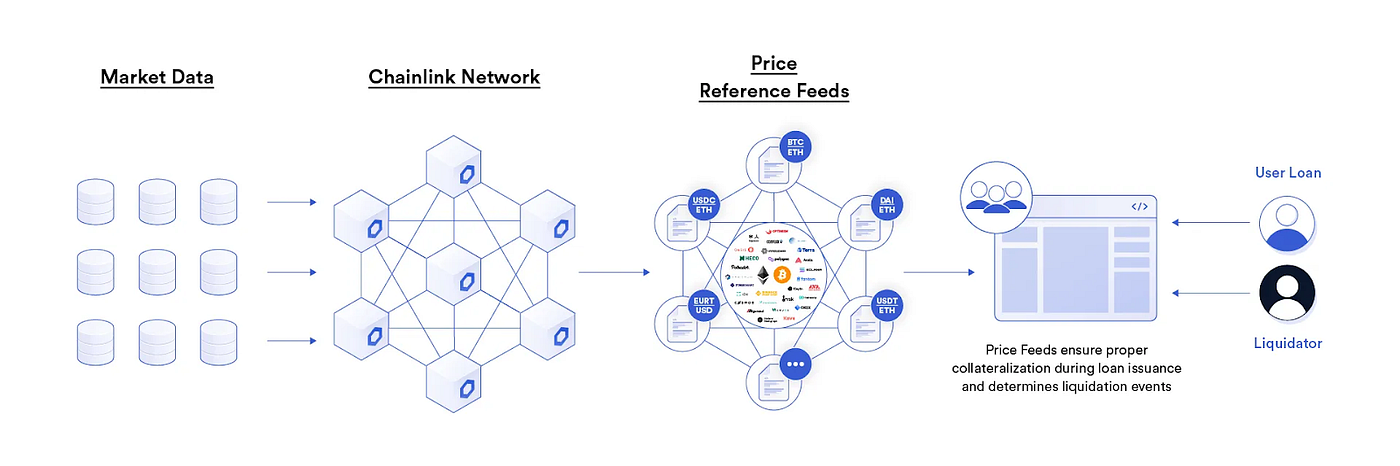
Chainlink Price Feeds are part of a broader category known as Data Feeds, which deliver reliable data from the external world into smart contracts. Here’s how they work:
- Data Aggregation. Chainlink Price Feeds aggregate data from multiple sources, including professional data providers, exchanges, and financial institutions. This process ensures that the price information is accurate and resistant to manipulation. A typical Price Feed is supported by up to 30 oracles, each independently retrieving data. These oracles use a consensus mechanism to agree on the most accurate price, which is then transmitted to the blockchain.
- Trigger-Pull Mechanism. One of the core features of Chainlink Price Feeds is the trigger-pull mechanism. This ensures that feeds are updated whenever there is a significant change in the price of an asset. For instance, if the price of Ethereum changes by a predefined percentage, the Price Feed is automatically updated, ensuring that the data in the smart contract is accurate and relevant.
- Heartbeat Updates. In addition to the trigger-pull mechanism, Price Feeds also incorporates heartbeat updates. These are regular updates that occur at fixed intervals, even if there has been no significant change in the asset’s price. Heartbeat updates guarantee that the price data remains relevant and that the feed does not go stale, providing an additional layer of reliability.
Why Are Chainlink Price Feeds Reliable?
The reliability of Chainlink Price Feeds stems from the robust architecture of the DON. Here’s why they are considered trustworthy.
- Decentralized Oracle Network (DON). By using multiple oracles, Chainlink reduces the risk of any single point of failure or data manipulation. The decentralization ensures that even if one oracle fails or is compromised, the overall feed remains accurate and trustworthy.
- High-Quality Data Providers. Chainlink partners with top-tier data providers who offer institutional-grade price data. This ensures that the information fed into smart contracts is sourced from reputable entities, reducing the likelihood of inaccuracies.
- Data Security and Integrity. The aggregation of data from various sources, coupled with the consensus mechanism, ensures that the final price fed into the blockchain is a reliable reflection of the market. This process is tamper-resistant and designed to protect against attacks or manipulation.
Which Networks Support Price Feeds?
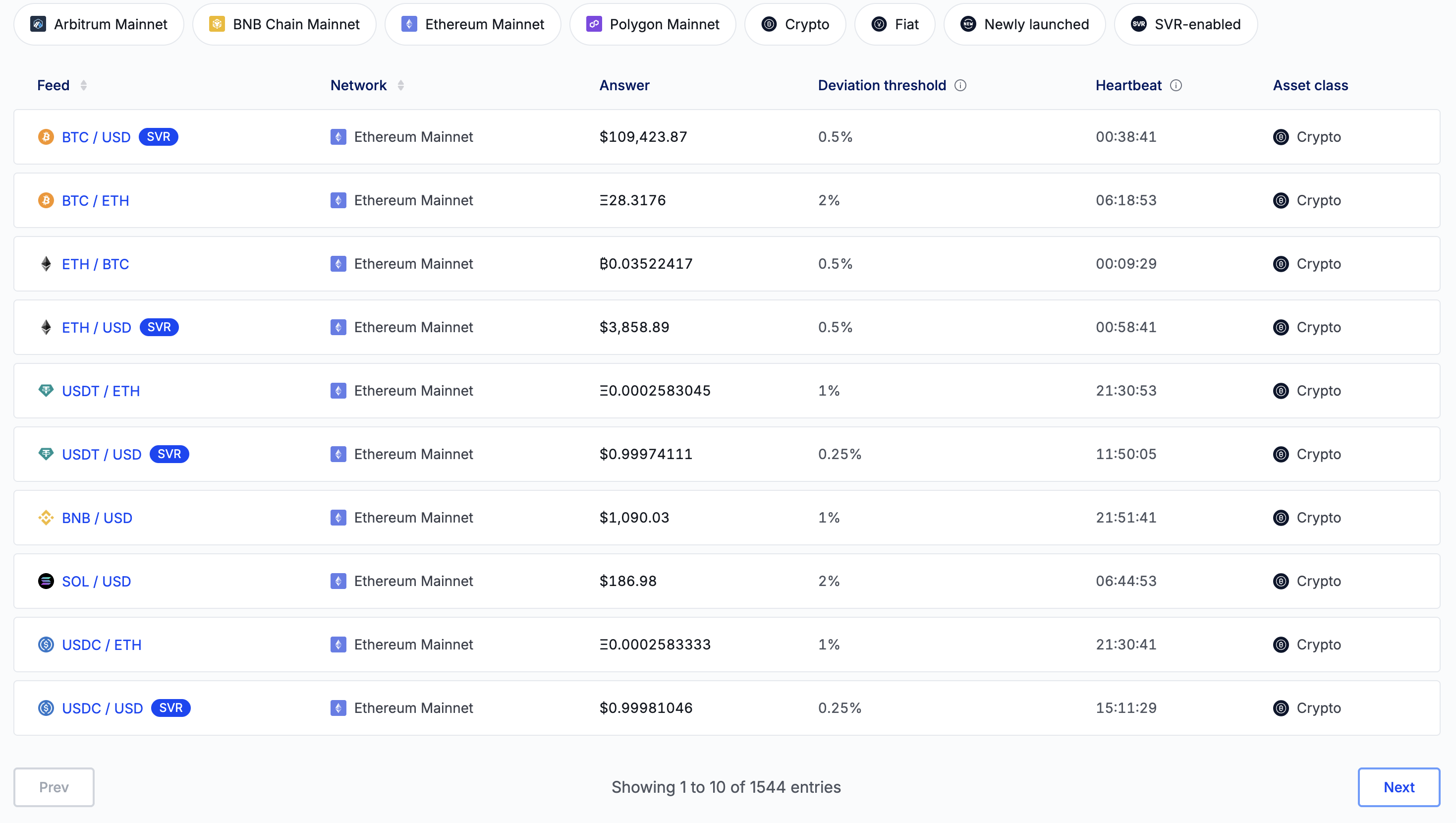
Chainlink Price Feeds are available on 34 blockchain networks, enabling a diverse array of decentralized applications (dApps) to leverage accurate and reliable price data. This broad support allows developers to build on their preferred platforms while ensuring access to trusted oracle services.
Ethereum. The largest and most widely used smart contract platform, Ethereum, hosts a significant portion of the DeFi ecosystem, where Chainlink Price Feeds are integral to many high-profile projects.
Binance Smart Chain (BSC). Known for its low transaction fees and fast processing times, BSC is a popular choice for DeFi projects that require cost-effective operations. Chainlink Price Feeds are widely used across BSC, providing secure data to numerous dApps.
Arbitrum. A high-performance blockchain renowned for its scalability and speed, Avalanche integrates Chainlink Price Feeds to support a growing number of DeFi applications, particularly those focused on trading and lending.
Polygon. As a layer 2 scaling solution for Ethereum, Polygon offers faster and cheaper transactions, making it a popular choice for dApps that require high throughput. Chainlink Price Feeds are crucial for the DeFi projects operating on Polygon, ensuring they receive reliable market data.
Fantom, Arbitrum, Optimism, and more. These additional networks also support Chainlink Price Feeds, providing developers with the flexibility to build on various platforms while maintaining access to high-quality oracle services.
The extensive availability of Chainlink Price Feeds across multiple blockchains ensures that developers can integrate accurate and secure price data into their dApps, regardless of the underlying network, thereby enhancing the functionality and reliability of their applications.
Which Major DeFi Projects Use Price Feeds
Chainlink Price Feeds are the backbone of over 1,000 apps, including some of the largest and most successful DeFi projects. Chainlink Price Feeds are essential to the operation of many leading DeFi projects, providing secure and reliable data that enables these protocols to function effectively across a variety of use cases. Here’s how some of these projects leverage Chainlink Price Feeds:
Compound
A decentralized interest rate protocol that relies on Chainlink Price Feeds to ensure the accuracy and fairness of its lending markets. Chainlink provides real-time price data for all supported assets, allowing Compound to calculate collateral values precisely, prevent manipulation, and maintain proper liquidation thresholds. This oracle integration underpins the reliability and transparency of Compound’s algorithmic money markets.
GMX
A decentralized perpetual exchange that integrates Chainlink Price Feeds to secure its trading operations. By using Chainlink’s low-latency, tamper-resistant market data, GMX ensures accurate mark prices for leveraged positions and fair liquidations even during volatile market conditions. This integration provides traders with confidence in execution fairness and strengthens the overall integrity of GMX’s derivatives market.
Aave (Money Markets)
Aave is a decentralized lending and borrowing protocol that uses Chainlink Price Feeds to secure its operations. By providing reliable price data, Chainlink ensures that loans are properly collateralized and that liquidations occur fairly, protecting the assets in Aave’s liquidity pools. The protocol’s co-founder, Stani Kulechov, highlights the importance of Chainlink’s oracle infrastructure in maintaining the security of the Aave ecosystem and enabling users to participate as liquidators, further securing the protocol.
Synthetix (Synthetic Assets)
Synthetix is a protocol for creating synthetic assets that track the value of real-world assets. The platform relies heavily on accurate and timely price data to ensure the correct valuation of these synthetic assets. Chainlink Price Feeds provides the decentralized, tamper-proof price data that Synthetix needs to maintain the integrity of its derivatives trading mechanism. Kain Warwick, the founder of Synthetix, emphasizes the importance of having a robust decentralized oracle solution like Chainlink to support the platform’s operations.
Lido (Staking)
Lido is a liquid staking protocol that allows users to stake their assets while still being able to use them in DeFi applications. Lido uses Chainlink Price Feeds to securely add support for a wide range of assets, streamlining processes and reducing security risks. Vasiliy Shapovalov, a member of Lido DAO, praises Chainlink for enabling DeFi protocols like Lido to quickly and securely integrate new assets, enhancing the protocol’s overall functionality.
Liquity (Stablecoins)
Liquity is a decentralized borrowing protocol that issues the stablecoin LUSD. The protocol uses Chainlink Price Feeds to secure $2.7B TVL from its collateral, redemptions, and liquidations. By integrating Chainlink’s reliable price data, Liquity can improve its capital efficiency and focus on developing production systems at a faster pace. The use of Chainlink oracles has been a clear step in enhancing the security and efficiency of the Liquity protocol.
These examples demonstrate the critical role that Chainlink Price Feeds play in the DeFi ecosystem, enabling a wide range of applications to operate securely and effectively. Whether for synthetic assets, money markets, decentralized exchanges, staking, or stablecoins, Chainlink provides the trusted data that these protocols need to function and grow.
Conclusion
Price Feeds are a fundamental component of the decentralized finance ecosystem, providing the accurate and reliable data necessary for various dApps to function. Without access to real-time price information from global markets and other protocols, many DeFi applications — such as lending platforms, decentralized perpetual derivatives, and prediction markets — would be unable to operate effectively.
Chainlink Price Feeds remain the most widely adopted and trusted solution in the Web3 ecosystem, providing the backbone for a wide range of decentralized applications. As the demand for secure, real-time data grows, Chainlink’s Price Feeds will likely remain a cornerstone of the blockchain and DeFi landscape.


.png)

.png)

.jpg)


.webp)