

The financial industry is undergoing a significant digital transformation, and major post-trade players like the Depository Trust & Clearing Corporation (DTCC), Euroclear, and Clearstream are building clearing systems. These firms are exploring the potential of digital assets, and Chainlink’s role could be even more important in this development than we think.
Deepbase will participate in related operations as a Chainlink Node operator, so we delve deeper and explore the potential of Chainlink in three of the world’s largest financial market infrastructures.
TL;DR
Clearings define Digital Asset Securities as digital tokens that represent or embody rights like regular Web2 securities. They accept tokenization of existing assets but also think about issuing blockchain-only securities.
Digital assets open the road for automation and transparency that only blockchains (distributed ledger technology in their terminology) can offer, and this automation can save up to $20 billion annually in infrastructure costs. Before institutions start using DAS, they have a lot of paperwork to do, like smart contract certifications to mitigate risks. Clearings understand blockchain pros and cons and emphasize the importance of geographic distribution of data centers, anonymization, and transaction proofs.
One of the most important things they see in DAS adoption is using robust oracles and “industry accepted cross-chain interoperability protocols”, which are clear hints to Chainlink Decentralized Oracle Network and CCIP.
Digital Assets Control Principles
In May 2024, DTCC, Clearstream, Euroclear, and Boston Consulting Group published a blueprint for an industry-wide digital asset ecosystem to accelerate the adoption of tokenized assets in the financial sector.
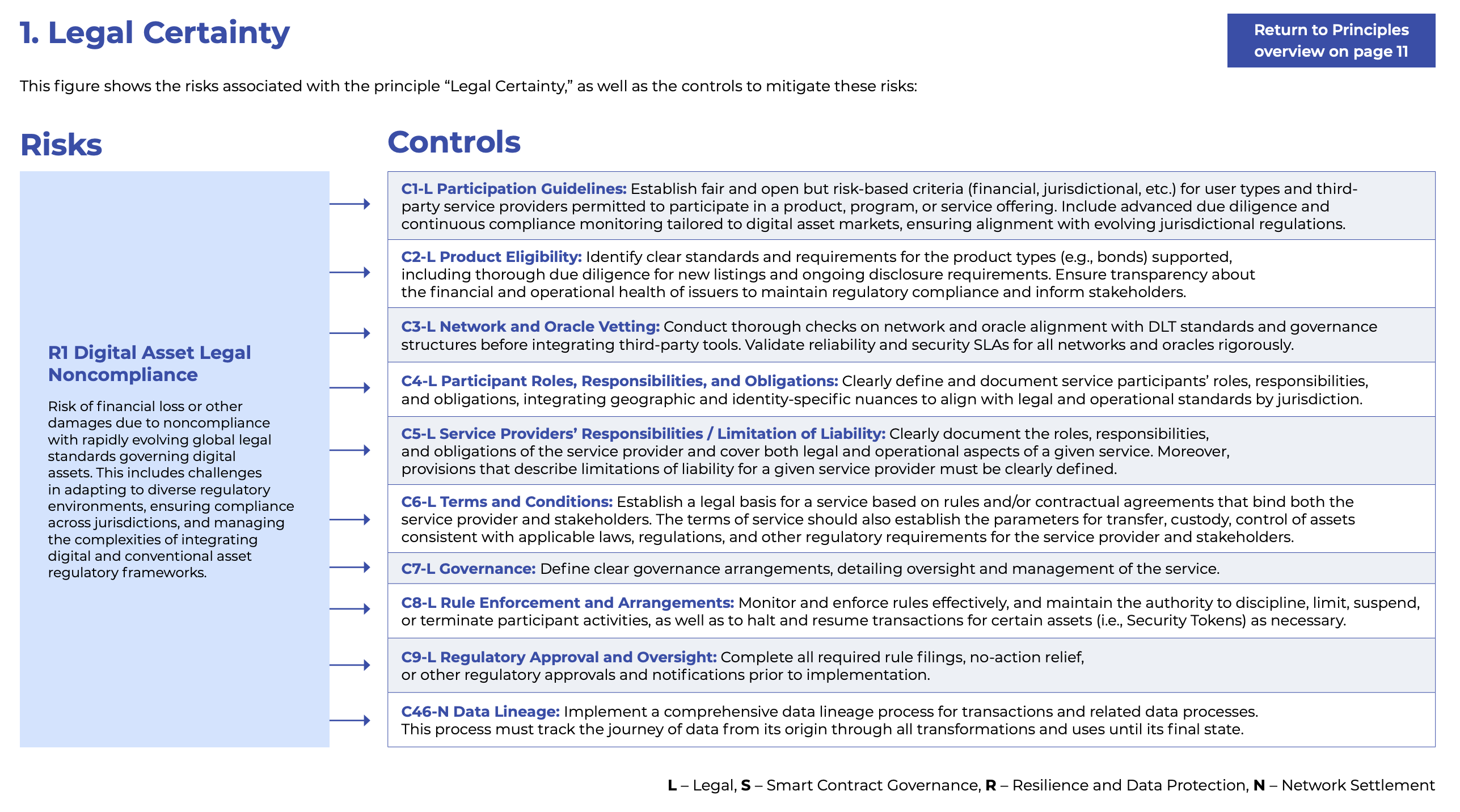
As a solution, they propose utilizing blockchain technology and smart contracts, particularly Chainlink services, to automate processes throughout the DA lifecycle. This approach promises to enhance the efficiency, transparency, and security of operations with DA while mitigating risks.
The Digital Asset Security Control Practices (DASCP) is a framework designed to address the complexities of the digital asset landscape. It enhances system resilience, safeguards customer assets, and facilitates seamless transactions through improved connectivity and interoperability.
The DASCP framework covers various value chain activities essential to the life cycle of DAS, including issuance, clearing, settlement, custody, and asset servicing. It is an asset class and technology-neutral, not advocating for any particular DLT architecture.
The creation of a global network of interconnected platforms for DAs, based on blockchain technology and smart contracts, has the potential to significantly advance the market.
However, close cooperation between market participants and regulators is essential for the successful implementation of this initiative.
The Potential Role of Chainlink
The emergence of DASCP is a significant step in addressing the complexities of the growing digital asset landscape. Designed to enhance system resilience, safeguard assets, and improve transaction efficiency, DASCP aligns seamlessly with Chainlink’s capabilities, creating a powerful synergy that benefits the entire digital asset ecosystem.
Chainlink, a decentralized oracle network, provides the essential infrastructure that underpins the security, reliability, and scalability required by DASCP. By facilitating the secure transfer of real-world data to blockchain-based smart contracts, Chainlink oracles enhance the reliability and trustworthiness of digital asset operations. This directly addresses the DASCP principles of security and resilience, mitigating risks associated with data manipulation and ensuring the integrity of smart contract executions.
Moreover, Chainlink’s Proof of Reserve and Cross-Chain Interoperability Protocol (CCIP) is instrumental in addressing key challenges in the digital asset space. Proof of Reserve enhances transparency by verifying the collateralization of tokenized assets, aligning with DASCP’s focus on safeguarding customer assets. CCIP, on the other hand, addresses the fragmentation issue by enabling seamless interoperability between different blockchain networks, facilitating efficient cross-chain transactions.
The collaboration between DASCP and Chainlink signifies a significant step towards the institutional adoption of digital assets. By combining a robust security framework with reliable oracle infrastructure, the industry is fostering a more secure, transparent, and interconnected digital asset ecosystem. This not only aligns with the vision outlined in the DTCC, Euroclear, and Clearstream whitepaper but also paves the way for a future where digital assets are seamlessly integrated into the global financial system.
The potential of this collaboration is immense, promising to unlock new opportunities for innovation and growth in the digital asset space. As the industry continues to evolve, the synergy between DASCP and Chainlink is likely to play a pivotal role in shaping the future of digital finance.
Potential Use Cases
Distributed Ledger Technology (DLT), the foundation of cryptocurrencies, is being actively integrated into the securities market, promising to revolutionize traditional processes. Chainlink emerges as a key player in this transformation, bridging the gap between blockchain-based smart contracts and real-world data.
Chainlink’s core functionality is to securely feed smart contracts with real-world data, such as asset prices, events, or calculations. This is crucial for automating complex securities market operations like transaction settlements, risk management, and the issuance of tokenized assets.
Automating Complex Operations
Chainlink’s ability to trigger smart contracts based on real-world data opens doors to unprecedented automation. For instance, smart contracts can automatically verify conditions like price targets or specific events, significantly reducing the time and cost of processing transactions. This also enhances transparency and reliability, as the blockchain records every step immutably.
DEXs and Tokenization
Chainlink’s data oracles are instrumental in creating decentralized exchanges for tokenized securities. DEXs allow for direct trading of assets on the blockchain, eliminating the need for intermediaries. This reduces counterparty risk and improves market liquidity and accessibility.
Real-World Examples
A detailed example showcases the power of Chainlink in a real-world scenario:
- Asset Tokenization. Private securities, like a private equity fund, are tokenized on a private blockchain.
- Token Transfer and KYC. The custodian moves the tokens to a public blockchain for broader distribution. Chainlink-powered smart contracts enforce KYC checks throughout the transfer process.
- Money Market Fund (MMF) Issuance and Tokenization. Simultaneously, an MMF is issued and tokenized for lending purposes.
- Collateralized Lending. Investors use their tokenized private equity fund shares as collateral to borrow MMF shares.
- Automated Lending Operations. Smart contracts handle the entire lending workflow — from deposit and loan issuance to repayment and interest distribution. Chainlink’s oracles ensure accurate data feeds for risk assessment and interest calculations.
Illustrative DASCP Controls
The mention of the Distributed Ledger Technology Applied to Securities Markets Control Principles framework highlights the importance of risk mitigation in this evolving landscape. Smart contracts, powered by Chainlink’s oracles, can implement specific controls for:
- Connectivity and Interoperability. Ensuring seamless token transfers across different blockchains.
- Regulatory Compliance. Enforcing investor accreditation and other regulatory requirements through smart contract logic.
- Resilience and Security. Mitigating risks like asset mismanagement through role-based access controls and emergency stop mechanisms.
- Operational Scalability. Handling high transaction volumes efficiently.
- Safeguarding Customer Assets. Implementing stringent controls over digital assets and smart contract functions.
The Future of Securities Markets
Chainlink’s role in connecting real-world data with blockchain-based smart contracts is pivotal for the future of securities markets. Its ability to facilitate automation, enhance security, and enable innovative financial products positions it as a critical infrastructure component for this emerging ecosystem. While the examples provided are illustrative, they underscore the potential for Chainlink to reshape how securities are issued, traded, and managed.
Conclusion
DTCC, Euroclear, and Clearstream are at the forefront of digital asset exploration, and Chainlink plays a crucial role in this process. The integration of Chainlink into the infrastructure of these companies can unlock new opportunities for the financial industry, making digital assets more accessible, efficient, and secure.
As blockchain technology continues to evolve and the popularity of digital assets grows, collaboration between traditional financial institutions and decentralized networks like Chainlink will be essential in shaping the future of financial markets.


.png)

.png)


.jpg)


.webp)